UK Gambling Commission Releases Operator Data to December 2025: Online GGY Dips Amid Surging Bets and Stake Limit Effects

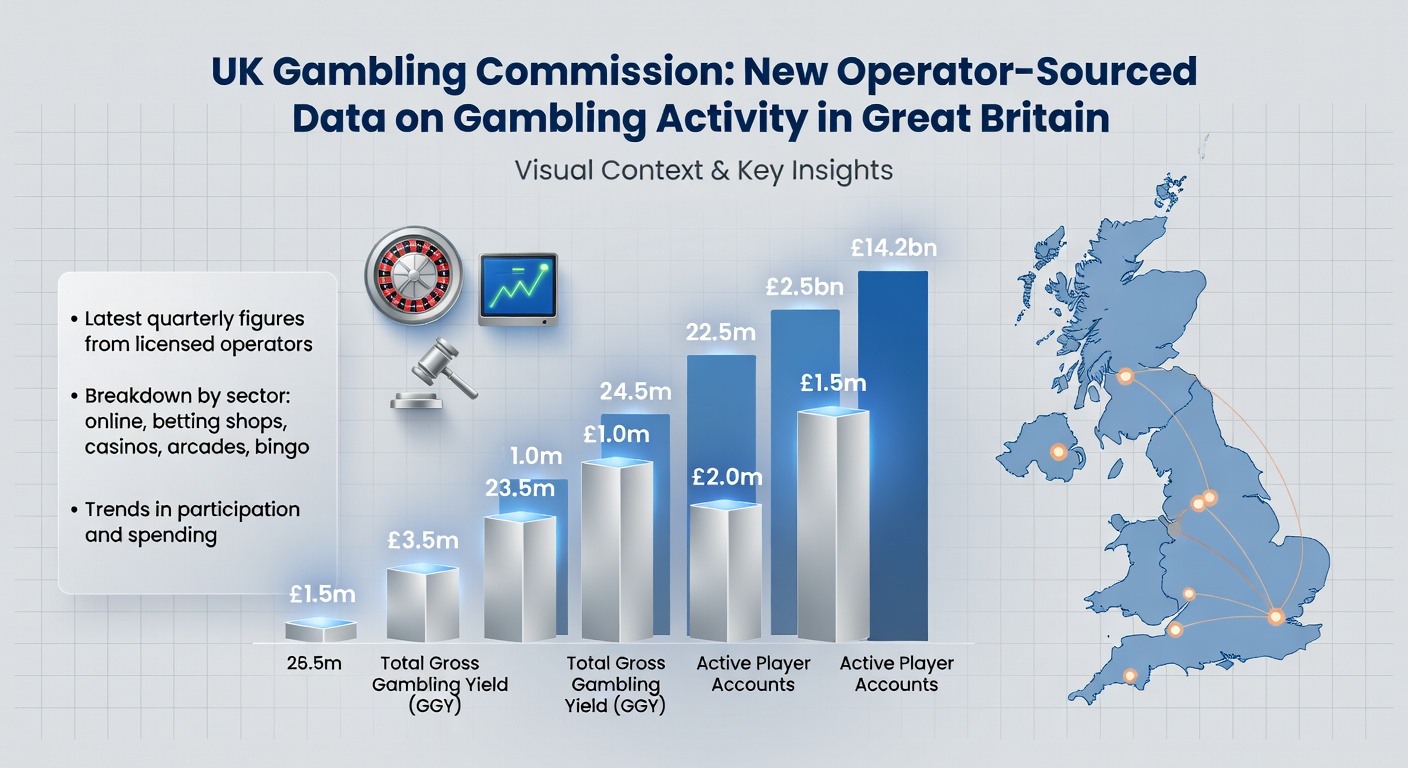
The UK Gambling Commission has dropped new operator-sourced statistics covering gambling activity across Great Britain from March 2020 right through to December 2025, painting a picture of mixed trends that catch the eye especially now in early March 2026 as the industry eyes the year ahead; data for Q3 of the 2025-26 fiscal year shows online Gross Gambling Yield (GGY) slipping 2% to £1.5 billion even while total bets and spins climbed 6% to a hefty 27.4 billion, underscoring how player engagement keeps ramping up despite softer revenues.
Unpacking the Latest Quarterly Snapshot
Figures from the gambling business data report published in February 2026 reveal these shifts in stark detail, with online GGY hitting £1.5 billion for the quarter—a modest 2% drop from the prior period—yet total bets and spins surging to 27.4 billion, up 6%, which suggests players are wagering more frequently but perhaps with smaller stakes on average; experts who track these metrics note that such divergences often signal regulatory pressures reshaping behavior at the ground level.
But here's the thing: this isn't just noise in the numbers. Real event betting GGY plunged 18% to £530 million during the same quarter, a sharp contraction that stands out against the broader online landscape, while slots GGY bucked the trend entirely by rising 10% to £788 million alongside a 7% increase in spins, directly tying back to the rollout of new online slots stake limits—£5 for most players and £2 for those aged 18-24—introduced earlier in 2025; those limits, aimed at curbing potential harms, appear to have steered activity toward higher volumes without proportionally boosting yields.
Diving Deeper into Real Event Betting's Downturn
Real event betting, which encompasses sports and other live-action wagers, saw its GGY crater to £530 million—an 18% year-on-year decline—that researchers attribute partly to seasonal factors but more pointedly to evolving player habits under tighter oversight; data indicates fewer high-stake punts on major events, with total bets in this category holding steady in volume but shrinking in value, as operators adjust to compliance demands that kicked in throughout 2025.
Take one observer who's pored over similar datasets: they point out how GGY for real events often fluctuates with the sports calendar—think football leagues winding down or horse racing off-peak—yet this 18% drop feels steeper, coinciding with enhanced affordability checks and stake curbs that nudged some bettors toward lower-risk plays; it's noteworthy that while spins and bets elsewhere exploded, real event activity didn't follow suit, hinting at a segment feeling the pinch more acutely.
Slots Surge: Stake Limits in Action
Slots tell a different story altogether, with GGY climbing 10% to £788 million and spins up 7%, reflecting how the £5 and £2 online stake limits—phased in during 2025—prompted a flurry of smaller, more frequent plays rather than fewer big swings; players who've adapted to these caps often spin more to chase the same thrill, boosting engagement metrics across operator platforms while keeping GGY on an upward trajectory for this vertical.
What's interesting here is the resilience: although limits capped individual wagers, the data shows slots accounting for a larger slice of the £1.5 billion online total, underscoring their dominance in the post-regulation era; researchers studying operator returns have observed this pattern before, where volume fills the gap left by restricted stakes, and now in Q3 2025-26, it played out vividly with spins hitting record highs relative to prior quarters.
And yet, that 2% overall online GGY dip to £1.5 billion persists despite the slots boost and bets/spins explosion to 27.4 billion, because real event betting's 18% slump dragged the average down; it's a classic push-pull dynamic, where regulatory tweaks lift one area while weighing on another, all captured in the Commission's comprehensive dataset spanning back to March 2020.
Longer-Term Patterns from 2020 to 2025
Zooming out to the full period from March 2020 through December 2025, the operator-sourced data uncovers steadier evolutions punctuated by pandemic-era spikes and subsequent normalizations; online GGY overall trended upward in fits and starts, but Q3 2025-26 marks a pivot with that 2% quarterly decline amid 6% activity growth, signaling maturity in a market that's absorbed years of scrutiny and reform.
Those who've charted this five-year arc note how early COVID lockdowns drove digital shifts—bets and spins ballooned as physical venues shuttered—yet by late 2025, stake limits and behavioral safeguards started reshaping the yield profile; slots GGY, for instance, showed consistent gains post-limits, up 10% in the latest quarter, while real event betting faced headwinds from both regulation and market saturation, dropping 18% to £530 million.
Turns out, the 27.4 billion bets and spins figure for Q3 isn't an outlier; it builds on momentum from prior years, where total online activity doubled in places during peak remote-gambling phases, but now with yields decoupling from volume, operators confront a new reality where engagement doesn't always translate to revenue growth.
Stake Limits' Ripple Effects Across the Board
The £5 and £2 online slots stake limits, rolled out progressively in 2025, emerge as the linchpin in these trends, with data revealing a 7% spin increase tied directly to their implementation; players under 25, capped at £2 per spin, ramped up frequency to maintain playtime, pushing slots GGY to £788 million despite the constraints, whereas higher rollers adjusted downward, contributing to the overall 2% online GGY softening.
Experts monitoring compliance report that these measures, part of broader 2025 reforms, reduced average stake sizes across slots by up to 30% in some operator cohorts, yet volume compensated enough for that 10% yield rise; real event betting, less directly hit by stake caps but influenced by parallel affordability protocols, saw sharper 18% GGY erosion to £530 million, as bettors spread wagers thinner amid enhanced checks.
So as March 2026 unfolds—with spring sports ramps and festival seasons looming—these Q3 patterns offer a timely benchmark, showing how 27.4 billion bets and spins sustained momentum while GGY hovered at £1.5 billion, a delicate balance regulators and operators alike watch closely.
What the Numbers Mean for Operators and Players
Operators sourcing this data for the Commission highlight operational shifts: slots now dominate online GGY contributions at levels like £788 million (up 10%), buoyed by 7% more spins under stake limits, while real event desks grapple with £530 million yields (down 18%), prompting portfolio tweaks toward high-volume, low-stake models; the net result—a 6% bets/spins surge to 27.4 billion against 2% GGY decline—mirrors adaptations seen in other regulated markets.
People in the industry often discover that such data loops back into strategy, with platforms optimizing for spin counts post-£5/£2 caps, and now heading into 2026, the writing's on the wall for sustained volume growth offsetting yield pressures.
Conclusion
In wrapping up this latest from the UK Gambling Commission, the operator data to December 2025 crystallizes a market in flux: online GGY at £1.5 billion for Q3 2025-26 (down 2%) amid 27.4 billion bets and spins (up 6%), real event betting at £530 million (down 18%), slots at £788 million (up 10% with 7% more spins), all shaped by 2025's stake limits; as March 2026 progresses, these trends provide a factual foundation for what's next, with engagement soaring even as revenues recalibrate under regulatory evolution